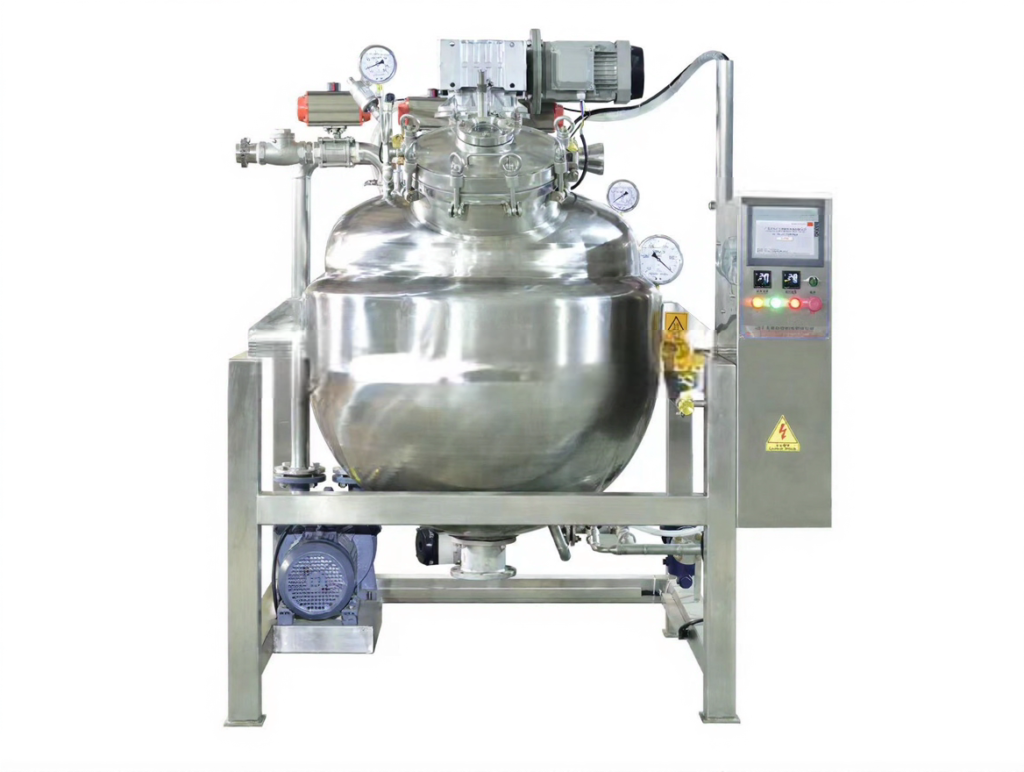
Ask any caramel or toffee plant what eats their margin, and the answer is rarely the recipe — it is the scorched batch. Sugar that sits too long against a hot jacket caramelises past the point of no return, and one burnt pan can cost a full shift of cleaning and rework. That is exactly the problem a vacuum toffee cooker with scraper stirring is built to solve. In this guide we walk through how a compact vacuum batch cooker works, the products it covers, the real specification numbers, and what to check before you buy one — with photos of an actual machine.
Why vacuum cooking matters for toffee and caramel
Toffee, caramel and milk candy bases are mixtures of sugar, glucose syrup, fat and milk solids. Cook them at atmospheric pressure and you need temperatures above 120 °C — hot enough that milk proteins brown quickly and sugar burns onto the pan wall. Cooking under vacuum lowers the boiling point, so the same water removal happens at a gentler temperature. Three things follow directly:
- Colour stays golden instead of drifting dark — the batch you cook at 09:00 matches the batch you cook at 17:00
- Flavour is protected — caramel notes stay creamy rather than burnt, which matters enormously for milk candy and nougat
- Less scorch on the jacket — and whatever does stick is continuously scraped away, which is the cooker’s second trick (more on that below)
Inside the machine: a pot, a scraper and a vacuum system
The cooker shown here is a compact single-vessel unit: a jacketed SUS 304 stainless pan with a motored scraper stirrer on top, a vacuum line with valves and gauges, and a control cabinet that houses the PLC and touch screen. Despite the small footprint, every element targets one goal — a fast, repeatable cook with no burnt spots:
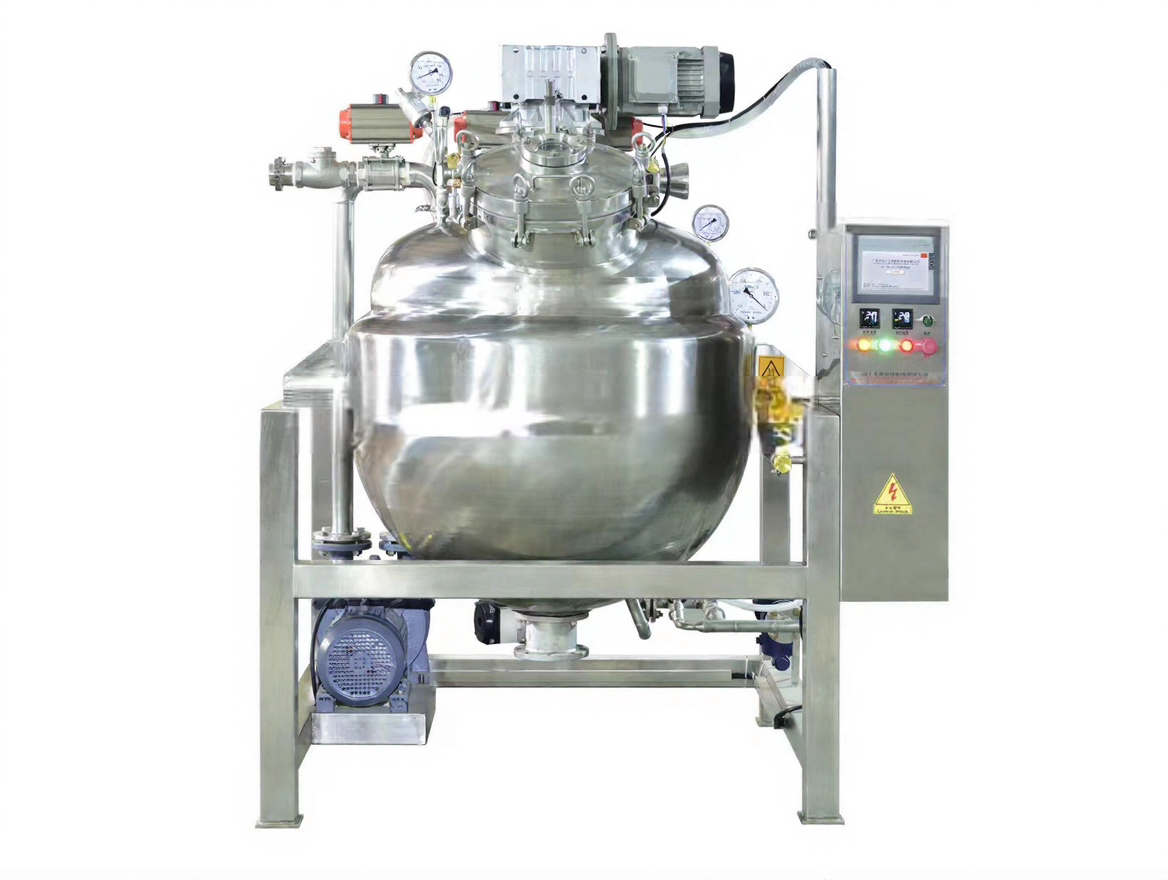
The critical detail is the stirrer. This machine stirs with a PTFE scraper that wipes the pan wall and bottom on every rotation. PTFE is food-safe, heat-tolerant and soft enough not to scratch the steel, while the scraping action does two jobs at once: it stops sugar from settling and burning on the hot surface, and it folds the batch so heat distributes evenly. For syrupy masses that love to stick — toffee above all — this is the difference between a smooth cook and a ruined pan.
Engineering note — “scorched batch” failures almost always start at the same place: the boundary layer of syrup against the heated wall. Any cooker that does not actively scrape that layer is asking the operator to watch the pot instead of running the line.
Automatic cooking, automatic vacuum
The control sequence is straightforward. The operator loads sugar, glucose and the dairy or fat phase, selects the recipe, and the machine takes over: heating and stirring run automatically, the vacuum stage pulls down on its own, and the cook ends at a repeatable endpoint rather than at an operator’s judgement call. On the touch screen, temperature and vacuum are visible in real time, and recipes can be stored so switching from a caramel to a toffee to a nougat base is a menu selection, not a retune.
Internationally known-brand electrical components keep the machine stable on sites where voltage dips and summer heat are normal — a small detail that decides whether the cooker survives its first humid monsoon season in a tropical plant.
What you can produce on it
A vacuum cooker with aeration-style stirring is one of the most versatile single machines in a candy plant. Beyond plain toffee, the same pot covers:
- Toffee and caramel — the core application, from chewy squares to hand-wrap styles
- Milk candy and nougat — the stirring system aerates and blends dairy masses evenly
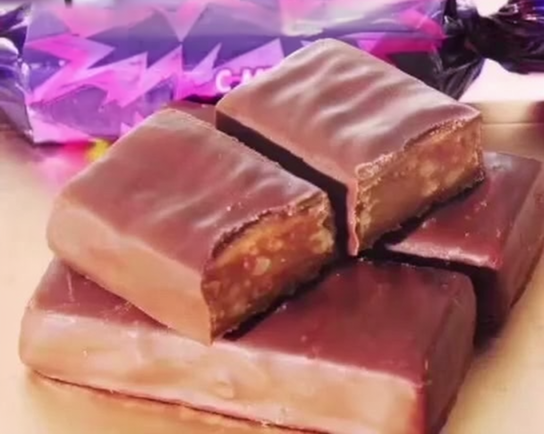
- Chocolate-coated toffee bars — the crunchy croquant-style centres popular in Eastern European and Middle Eastern markets, cooked as a brittle nut-and-caramel mass
- Starch-mould chews and ginger candy — starch-jellied bases that need a clean, evenly cooked syrup
- Candy-bar fillings — caramel and toffee layers for cereal-bar and chocolate-bar production
If your product map is broader — gummies, liquorice, hard candy — the cooker is normally one station inside a bigger flow. Our rainbow gummy production line guide and liquorice line guide show how cooking, extruding and packing connect into one line, and our machinery range lists the matching upstream and downstream units.
Reference specification
The figures below are the typical working parameters of this class of compact vacuum batch cooker (model class ~300 L, single pan):
| Parameter | Typical value |
|---|---|
| Production capacity | 400–500 kg/h |
| Installed power | 3 kW, 380 V, 50 Hz |
| Steam pressure | ≤ 0.6 MPa |
| Steam consumption | 300–400 kg/h |
| Overall dimension | 1780 × 1220 × 2070 mm (L×W×H) |
| Net weight | ~700 kg |
Two readings matter for planning. First, steam consumption of 300–400 kg/h tells you the boiler duty — plants often underestimate this and end up choking the cooker at peak load. Second, the 0.6 MPa steam ceiling pairs with the vacuum system to define the low-temperature window; push the jacket harder and you give back the colour protection you bought the vacuum for.
Checklist before you buy a vacuum toffee cooker
- Scrape coverage, not just stirring. Ask whether the scraper contacts both the wall and the bottom, and what the PTFE pad replacement interval is.
- Vacuum endpoint control. The machine should end the cook on a measured vacuum/temperature pair, not a timer.
- Recipe memory. Multiple stored recipes on the PLC mean one machine can serve toffee, caramel and nougat production the same week.
- Steam reality check. Confirm your boiler can deliver 300–400 kg/h at 0.6 MPa continuously, not just on a cold start.
- Material and finish. Full SUS 304 contact surfaces, hygienic seals, and open access under the pan for cleaning.
- Commissioning. On-site start-up with your actual recipe is where a cooker is truly tuned — make it part of the contract, as we do in our turnkey project process.
Frequently asked questions
Is a vacuum cooker only for toffee?
No. Caramel, milk candy, nougat, starch chews, ginger candy and croquant-style bar fillings all run in the same pan. The recipe memory on the PLC is what switches between them.
What capacity should I plan for?
This class of cooker delivers roughly 400–500 kg/h of cooked base. Match that to your forming and wrapping capacity downstream — a cooker that outruns the line just holds hot batch, which is the condition scorching loves.
Can it replace my open pan?
For light-coloured toffee, caramel and dairy masses, yes — and usually with less rejection. For products where deep colour development is intentional, an open pan still has a place in some recipes.
How does this fit a full toffee line?
Cooker, forming or cutting table, cooling and a wrapping machine make the standard flow. For line-level planning and budgets, our production line cost breakdown explains the same budgeting logic that applies to toffee projects.
Get a cooker sized to your recipe
The fastest way to a correct quotation is to tell us what you cook. Send us your product list and target capacity — our engineers will reply within 24 hours with a cooker or complete line configuration, the utility list and honest capacity numbers. Delivered projects are documented in our case studies.