Aerating Cooker: Density Control in Nougat, Marshmallow and Cream Fillings
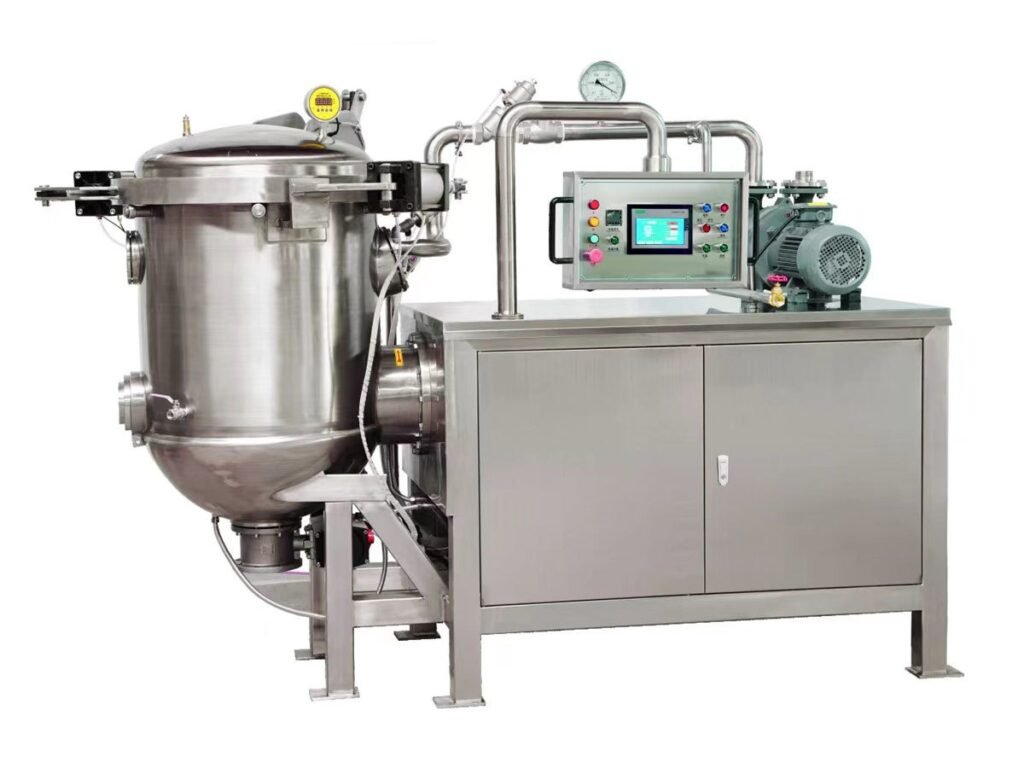
Air is the cheapest ingredient in a candy factory, and the easiest one to get wrong. A nougat that feels waxy, a marshmallow that collapses on the packing line, a cream filling that spreads instead of holding its shape — in most cases the recipe was fine and the aeration was not. This guide looks at what an aerating cooker actually does, how density is controlled batch after batch, and which numbers to settle before you specify one.
Aeration is a formulation decision, not an afterthought
Whipping does three things at once: it folds air into the mass, it breaks that air into smaller bubbles, and it sets the protein or gelatin network that holds those bubbles in place. The visible result is density, and density drives almost every property your customer notices.
| Product family | Typical density | What the eater feels |
|---|---|---|
| Marshmallow, extruded foam | 0.25 – 0.45 g/cm³ | Soft, springy, light; collapses if over-aerated |
| Chewy nougat with nuts | 0.90 – 1.15 g/cm³ | Firm chew that suspends inclusions without sinking |
| Protein / meringue candy | 0.35 – 0.60 g/cm³ | Crisp-to-chewy bite, quick dissolve |
| Cream filling for biscuits and wafers | 0.60 – 0.85 g/cm³ | Smooth, short texture, holds a clean bite |
Two failure modes account for most aeration complaints. Over-aeration gives a mass that looks impressive in the bowl and then loses volume in the depositor, sticks to the cooling belt and weighs light at the checkweigher. Under-aeration gives a dense, waxy bite, poor volume yield and a piece that feels expensive to produce because every kilogram contains less air and more sugar.
Neither is solved downstream. A cooling tunnel cannot put air back, and a depositor cannot take it out.
Inside an aerating cooker
A production aerating cooker is a jacketed vessel with a purpose-built whipping tool, a sealed shaft and a controlled air path. Every element exists to make one batch repeat the last one.
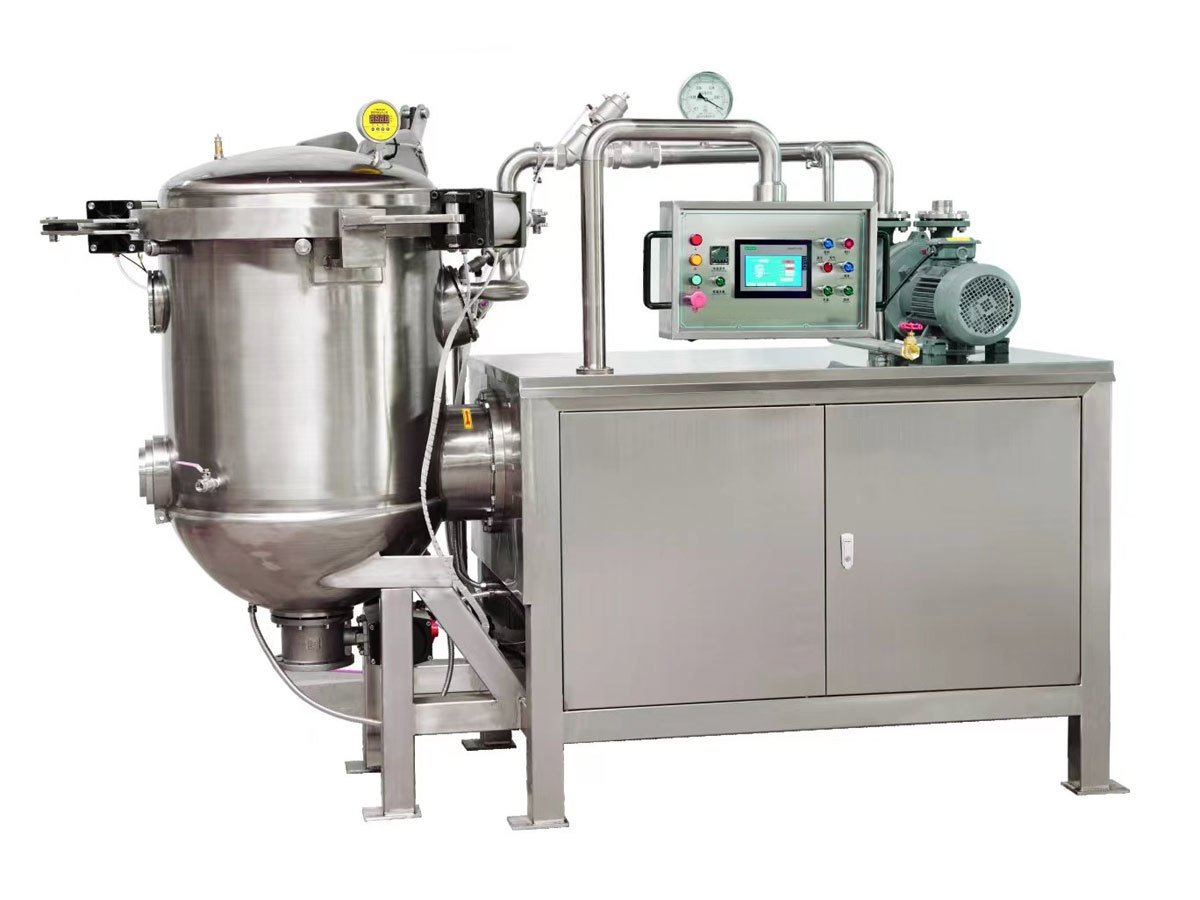
- Jacketed bowl, fully stainless. A 5 mm 304 shell with a 5 mm insulated jacket holds the mass at whipping temperature. Jacket water between 30 °C and 85 °C covers marshmallow, nougat and cream systems without scorching the protein.
- Sealed agitator shaft. A mechanical seal is what allows pressure inside the bowl. Without it, air escapes around the shaft and the density you set on the screen never reaches the product.
- Air injection up to 0.5 MPa. Compressed air at 0.6–0.8 MPa is regulated down and injected into the mass. Higher pressure means finer dispersion, not simply more air — the two are set separately.
- Vacuum option. Pulling a vacuum after whipping enlarges and evens out the bubble size, which is how you get a fine, stable crumb instead of large irregular holes.
- PLC and touchscreen with speed stages. The panel stores multi-stage whipping profiles per product, so a shift change does not become a recipe change.
The tooling matters as much as the vessel. Scraper frames, wire whips and paddle combinations behave differently on the same mass: a scraper keeps heat moving off the jacket wall, a whip builds bubble structure, and a paddle folds inclusions without destroying it. Specify the agitator around your product list, not the other way round.
The batch cycle, stage by stage
- Charge. Cooked syrup and the whipping agent — gelatin, egg albumen, soy or milk protein — go in at the temperature the recipe specifies. The syrup itself is cooked elsewhere; our vacuum toffee cooker guide covers that step and why low-temperature cooking protects colour.
- Blend at low speed. No air yet. The goal is a homogeneous mass at a known temperature, because density control starts from a consistent base.
- Whip with air injection. Speed and air pressure ramp together. This is the stage that decides final density, and it is measured, not guessed.
- Vacuum deaeration, if specified. Large bubbles are drawn out and the structure tightens. The same mass can end up 10–15 % denser here, so recipes written with vacuum must not be run without it.
- Discharge. The mass leaves at a set temperature straight to the depositor, extruder or cooling belt. Every minute between discharge and forming costs structure.
Why multi-stage whipping beats one speed
Running the agitator at a single high speed is the most common shortcut, and the most common reason two batches from the same recipe look different. Structure is built in stages: a high-torque stage to develop the protein network, a second stage to subdivide the bubbles, and a short low-speed stage to stabilise before discharge. Each stage has its own time and speed, and each one needs to be repeatable.
That is what the recipe memory on the PLC is really for. When a product’s density drifts, an operator should be able to compare stage times with the master recipe instead of adjusting by feel. Density is checked the simplest way there is — weighing a fixed cup of mass — and logged per batch. A 200 ml cup, filled level and weighed, is more useful than any inline instrument that nobody calibrates.
What you can run on it
The machine is built around aerated sugar systems, which covers a wider product range than the name suggests:
- Nougat and chewy aerated bars — including nut and fruit inclusions added at the folding stage.
- Marshmallow and extruded foam — where density control decides whether the rope holds its shape on the belt.
- Protein and meringue-based candy — the classic aerated candy body.
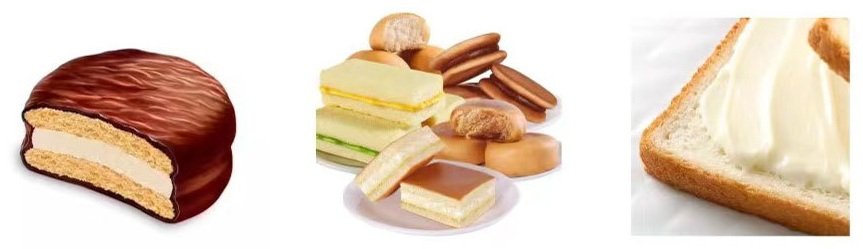
- Cream fillings for sandwich biscuits, wafers and coated bars, where aeration sets spreadability and bite.
Reference specification
| Parameter | Value |
|---|---|
| Power supply | 380 V, 50 Hz, 25 kW |
| Output | Up to 600 kg/h, depending on recipe and cycle time |
| Bowl material and thickness | 304 stainless steel, 5 mm shell, 5 mm insulated jacket |
| Bowl dimensions | 700 mm inner diameter, 0.33 m³ working volume |
| Jacket water temperature | 30 – 85 °C |
| Compressed air supply | 0.6 – 0.8 MPa |
| Aeration pressure | Up to 0.5 MPa, with vacuum option |
| Overall dimensions | 2700 × 1250 × 1800 mm |
| Net weight | 1300 kg |
Treat the output figure as a ceiling, not a promise. A dense nougat with a long whipping profile will not reach it; a light marshmallow with a short cycle might. Size the machine on kilograms per batch and batches per hour for your own recipe.
Where the aerating cooker sits in the line
Aeration is one station in a chain that has to be matched end to end: cooking, aeration, forming, cooling, cutting and wrapping. The cooker delivers syrup at a stable temperature and solids; the aerating cooker sets density; the depositor or extruder sets piece weight; the cooling tunnel sets the final texture. If any two of those are sized for different throughputs, the buffer between them becomes the bottleneck and the operators start shortening cycle times to keep up — which is exactly how density drifts. Our turnkey projects are laid out as a single line for that reason.
For the next station downstream, the candy extruder guide covers heads, dies and piece-weight control. If your aerated mass is going into starch-moulded or rainbow-layered products, the starch gummy line guide and the rainbow gummy line guide show how the same mass behaves in a different forming route.
Checklist before you specify one
- Density targets per SKU, in g/cm³ or as a cup weight. This one number decides agitator type, air pressure range and whether you need vacuum.
- Batch size against depositor cycle. A 0.33 m³ bowl suits a batch process that discharges into a hopper; a continuous depositor may want two smaller units rather than one large one.
- Whipping agent system. Gelatin, albumen and protein systems need different jacket temperatures and different shear. Tell the supplier which ones you actually use.
- Vacuum or not. Decide before the order. Retrofitting a vacuum system to a sealed vessel is a rebuild, not an accessory.
- Seal service life and spares. The mechanical seal is the one part that wears; ask for its expected life and keep one on the shelf.
- Cleaning routine. Confirm the bowl drains completely, the agitator lifts or removes easily, and no product hides under the scraper frame.
Frequently asked questions
Do I still need a separate cooker?
Usually yes. The aerating cooker holds temperature well, but its job is whipping, not boiling off water. Syrup is cooked to a target solids content in a cooker and then transferred; trying to do both in one vessel stretches the cycle and makes density harder to repeat.
Can one machine run marshmallow and nougat?
Yes, with different agitators and recipes. The two masses want different densities, jacket temperatures and whipping times, so the practical question is how quickly you can change tooling and recall a recipe — not whether the vessel is capable.
What does the vacuum option actually buy me?
A finer, more uniform bubble structure and a tighter density spread between batches. For marshmallow and fine cream fillings that is worth having; for a dense nut nougat the gain is smaller.
How do I keep density stable across shifts?
Fix three things: the recipe stored on the PLC, the cup-weight check frequency, and the syrup temperature at charge. Most density drift we see on site traces back to the third one — the mass entering the bowl is already different from the one the recipe was written for.
Size the aerating cooker around your product
Send us your product list with target densities, batch sizes and the fillings or candy bodies you plan to run, and we will come back with an agitator configuration, an aeration pressure range and a realistic output figure for your recipes. Start from the machinery range to see how the cooker, aerator and forming equipment are matched, or send your requirements and an engineer will reply within 24 hours.